


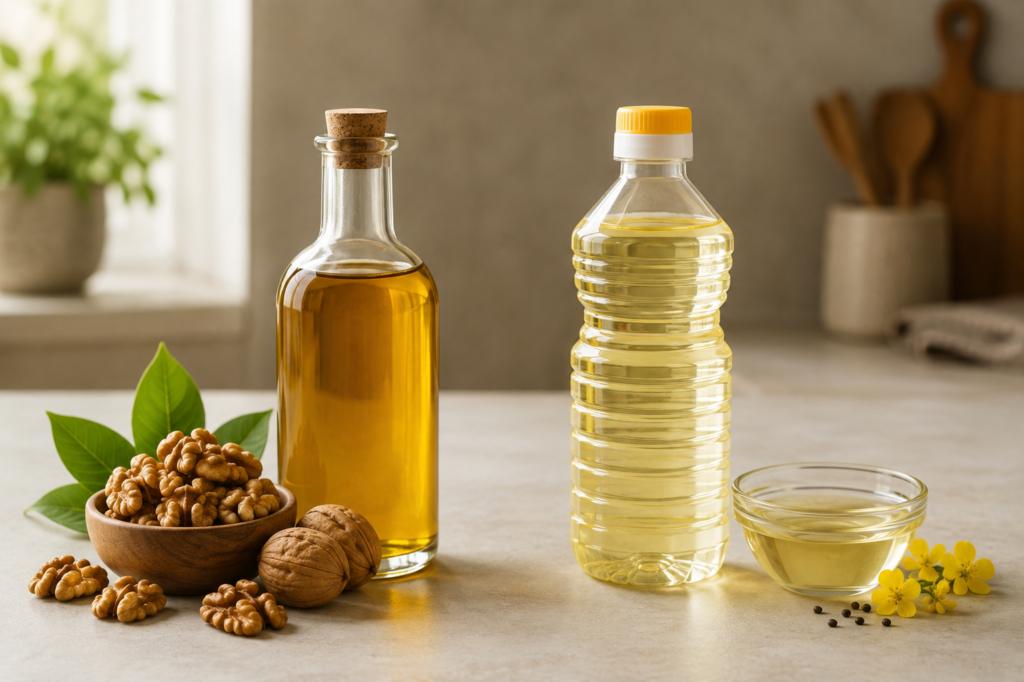
Here is the objection that almost every first-time walnut oil buyer has: “₹650 for 100ml, when I can buy a litre of refined sunflower oil for ₹120? That’s irrational.” It’s a reasonable objection, on the surface. But it compares two oils that are not used in the same way, for the same purpose, in the same quantities. Once you understand the difference in function, the price-per-use calculation changes significantly.
This is not a piece that will tell you walnut oil is magic and sunflower oil will kill you. Both oils have appropriate uses. The question is whether you understand what those uses are, and whether ₹650 for a bottle that lasts 6 to 8 weeks at correct usage makes practical sense for you.
What refined oil actually is, and what the refining removes
Most cooking oils sold in India, sunflower, soybean, cottonseed, rice bran, are refined, bleached, and deodorised (RBD) through a process involving heat (often 200°C+), chemical solvents (typically hexane), and further treatments to remove colour and odour. The process extends shelf life and creates a neutral-flavoured, stable oil suitable for high-heat cooking.
What refining also removes, or significantly reduces:
- Natural antioxidants (Vitamin E, polyphenols) that were present in the raw oil.
- Omega-3 fatty acids, the most heat-sensitive fatty acids, largely destroyed during high-temperature processing.
- Flavour compounds, which is why refined oil tastes like nothing.
- Phytosterols, plant compounds with documented cholesterol-management associations.
For high-heat cooking, frying, deep frying, high-temperature sautéing, refined oil is actually the right choice. Its stability at high temperatures means it doesn’t produce harmful oxidation products as quickly as unrefined oils. Using expensive cold-pressed oils for deep frying destroys their nutritional value and wastes money.
What cold-pressed walnut oil is, and why it’s different
Cold-pressed walnut oil is extracted mechanically at temperatures below 50°C, no heat, no solvents. The fatty acid structure, the antioxidants, and the micronutrients are largely preserved. The result is an oil with a measurable, active nutritional content, not the inert fat that refined oil becomes after processing.
Cold-Pressed Walnut Oil vs Refined Sunflower Oil
| Compound | Cold-Pressed Walnut Oil | Refined Sunflower Oil |
|---|---|---|
| Omega-3 (ALA) | ~14g per 100ml, one of the richest plant-based Omega-3 sources | ~0.2g per 100ml, trace amounts after refining |
| Vitamin E (tocopherols) | ~20mg per 100ml, active antioxidant | ~6mg per 100ml, partially degraded |
| Polyphenols and antioxidants | Present, contribute to flavour and shelf stability | Largely removed by refining and deodorising |
| Phytosterols | Present, research links these to cholesterol management | Reduced by refining |
| Smoke point | ~160°C, low, unsuitable for high-heat frying | ~230°C, high, suitable for frying |
| Flavour | Rich, nutty, distinctive, a flavour ingredient | Neutral, flavour-invisible in cooking |
| Shelf life (open) | 4 to 6 months, polyunsaturated fats oxidise over time | 12 to 18 months, stable against oxidation |
How to actually use cold-pressed walnut oil
The critical misunderstanding is treating walnut oil like a substitute for your regular cooking oil. It isn’t. Walnut oil is a finishing oil and a flavour ingredient, not a frying medium.
Finishing oil, the primary use
Add a teaspoon after cooking, off the heat. Drizzled over a dal, a roasted vegetable dish, a simple salad, or pasta just before serving. The flavour contribution is immediate and noticeable. The Omega-3 is preserved because it hasn’t been heated. This is the correct way to use walnut oil, and it’s the basis of the cost-per-use argument.
Salad dressings
The rich, slightly earthy-nutty flavour of walnut oil makes an outstanding salad dressing base, particularly with a wine vinegar or lemon juice acid component. A tablespoon of walnut oil, a tablespoon of apple cider vinegar, a pinch of salt and mustard, better than most commercial dressings.
Light sautéing at medium-low heat
For gentle sautéing of aromatics (garlic, onion, ginger) at medium-low temperatures, below 160°C, walnut oil is appropriate. Keep the flame low and watch carefully. The moment it begins to smoke, remove from heat, the Omega-3 fats are degrading above that temperature.
Hair care
2 tablespoons warmed and massaged into the scalp, left for 30 to 45 minutes before washing. The Omega-3 and Vitamin E content supports scalp health and hair shaft structure. Particularly good for dry, brittle hair.
The per-serving cost argument
A ₹650, 100ml bottle of cold-pressed walnut oil at 1 to 2 teaspoons per use gives you approximately 30 to 50 uses. That works out to ₹13 to ₹21 per use, comparable to what you pay for a premium salad dressing from a restaurant or specialty store. At that scale, the price objection dissolves.
The comparison to a ₹120 litre of refined sunflower oil is category confusion, you’re comparing a flavour-and-nutrition ingredient (walnut oil) with a cooking medium (refined oil). Both belong in a well-equipped kitchen. They serve different functions and neither replaces the other.
Which walnut oil to buy, what to look for
- Cold-pressed label: The most important indicator. “Expeller-pressed” is also acceptable. It uses mechanical pressure without solvents, though temperatures may be slightly higher than true cold-pressing.
- FSSAI certified: For any food product in India, FSSAI certification is non-negotiable.
- Origin specificity: “Kinnaur” or specific Himalayan valley origin is a quality signal. It tells you where the walnuts were grown, not just where the oil was bottled.
- Dark glass bottle: Cold-pressed oils are sensitive to light degradation. Dark glass is a functional quality indicator.
- Freshness: Check the pressing or bottling date where available. Cold-pressed walnut oil has a finite fresh-oil window. Older stock loses its flavour and nutritional character.
Buy Kinnaur Cold-Pressed Walnut Oil, ₹650
From handpicked Kinnaur walnuts. FSSAI certified. Rich in Omega-3. Dark glass bottle. Free delivery above ₹2,500.
Add to Cart → https://kinnaurdrinksandfoods.com/product/walnut-oil/
Frequently asked questions
Can I replace my regular cooking oil with walnut oil?
For high-heat cooking, frying, tempering, stir-frying, no. Walnut oil’s smoke point (160°C) is too low. Use your regular refined oil for these applications and use walnut oil as a finishing oil and dressing base. They complement each other; walnut oil does not replace refined oil.
Does walnut oil help lower cholesterol?
Research on walnut oil specifically (as opposed to whole walnuts) for cholesterol is limited. Research on diets rich in Omega-3 fatty acids and monounsaturated fats more broadly does show associations with improved lipid profiles. Walnut oil is aligned with those nutritional patterns, but we cannot make specific health claims about its effect on cholesterol for any individual.
Can people with nut allergies use walnut oil?
No. Walnut oil is pressed from walnuts and may contain walnut proteins. People with tree nut allergies, specifically walnut allergy, should not use this product. Cross-reactivity between walnut and other tree nut allergies is well-documented. Consult your allergist.