


The Complete Guchchi Guide: What It Is, Why It Costs What It Costs, and How to Cook It
The first thing anyone says when they learn the price of Guchchi mushrooms is: “₹X for a mushroom? Is this a joke?” It is not. And once you understand why the price is what it is — not because of marketing, not because of artificial scarcity, but because of the fundamental biology of the plant -the question changes from “why so expensive” to “why isn’t this in every kitchen that takes food seriously.”
This is the complete Guchchi guide: what it is, why it costs what it costs, how to cook it correctly, and what to do if you’ve been cooking it wrong.
What is Guchchi? The biology of scarcity
Guchchi (Morchella esculenta) -also known as Morel mushroom -is a member of the ascomycete fungal family. It grows in specific forest ecosystems at specific altitudes, and its life cycle is triggered by a very particular set of conditions: snowfall followed by warming temperatures, adequate soil moisture, and the presence of specific host trees.
Here is the fact that explains everything: Guchchi cannot be commercially cultivated. Decades of attempts by mycologists, food scientists, and commercial agricultural operations have failed to produce reliable large-scale cultivation of Morchella esculenta. The fungus has a complex relationship with soil microbiome, host trees, and environmental triggers that cannot be replicated in a controlled environment at commercial scale.
Every gram of Guchchi that reaches your kitchen was collected by hand from a forest — by a person who knows which clearings, which slopes, and which trees to look near. The supply is determined entirely by what nature produces. In a high-snowfall year with ideal spring warming, the yield is better. In a poor snowfall year, it’s less. No amount of market demand changes this.
Where Guchchi grows in India, and why Kinnaur
Guchchi grows in specific forest ecosystems across northern India: the Kangra Valley, Kinnaur district, Kullu-Manali, parts of Uttarakhand, Jammu and Kashmir. Not every Himalayan forest produces it. The specific soil composition, altitude, tree cover, and snowfall pattern all determine whether a forest floor will produce Guchchi each spring.
Kinnaur and surrounding areas of Himachal Pradesh are among the most productive Guchchi regions in India. Our Guchchi is collected by tribal community members who have generational knowledge of the specific forest locations and the timing of the harvest. This is not a romanticised claim — it is the practical reality of sourcing a wild ingredient that grows nowhere near roads or markets.
The flavour -what you’re actually buying
Guchchi has an earthy, intensely umami character -deeper and more complex than cultivated mushrooms (button, oyster, shiitake) and genuinely different from anything else in the Indian kitchen. The closest analogue is the French black truffle -not in flavour exactly, but in the category of “ingredient that transforms a dish by its presence alone.”
The flavour is delicate despite its intensity. This is the key paradox of Guchchi -it is powerful, but it demands that you cook it with restraint. Strong spices, high heat, and aggressive seasonings destroy exactly the character that makes it worth buying.
The complete Guchchi cooking guide
Step 1: Rehydration -the most critical step
Always begin with rehydration. Never cook dried Guchchi without rehydrating first — the texture will be leathery and the flavour uneven.
- Rinse the dried mushrooms briefly under cold water to dislodge any forest debris.
- Soak in warm (not boiling) water for 20–30 minutes until fully soft and pliable.
- Critical: Strain and KEEP the soaking liquid. This amber, Guchchi-flavoured liquid is culinary gold -it goes into the dish.
- Gently squeeze excess water from the rehydrated mushrooms and they’re ready.
Step 2: The slow sauté -the correct cooking method
This technique is non-negotiable for Guchchi. High heat destroys the flavour compounds. Slow, gentle heat in fat develops and concentrates them.
- Heat 1–2 tablespoons of unsalted butter or ghee in a heavy-bottomed pan over medium-low heat.
- Add the rehydrated Guchchi without crowding the pan. Cook in batches if necessary.
- Add a generous pinch of salt.
- Cook slowly for 5–8 minutes, turning occasionally. The mushrooms will release liquid — let it reduce and concentrate in the pan.
- Add the strained soaking liquid to the pan. Let it reduce by half.
- The pan liquid at this point is the Guchchi sauce -deeply flavoured and the heart of the dish.
The classic Guchchi pulao
This is the dish. Everything else -the price, the soaking, the slow sauté — exists to reach this moment.
- Par-cook basmati rice (about 70% done) using the absorption method.
- Add the sautéed Guchchi and its pan liquid over the top of the rice.
- Cover tightly with a lid and place on the lowest possible heat (or use a tawa as a heat diffuser) for 10–12 minutes — the dum method.
- Remove from heat and rest, lid on, for 5 minutes before serving.
What to add? Salt, the Guchchi, and its liquid. That is all. No tomatoes. No chillies. No garam masala. Perhaps a strand of saffron bloomed in warm milk, added at the dum stage, if you want colour. The mushroom is the dish – everything else should support it, not compete with it.
What NOT to do with Guchchi
These are the mistakes that waste your investment:
- Adding strong spices: Turmeric, red chilli powder, strong garam masala -all will overpower the delicate earthy umami of Guchchi completely. If you cannot taste the mushroom distinctly, you’ve over-spiced it.
- High heat: Rapid frying or stir-frying destroys the flavour compounds. The slow sauté method is not optional.
- Discarding the soaking liquid: This is the most common mistake. The amber soaking liquid contains a significant proportion of the flavour -pouring it down the drain is like throwing away the sauce.
- Adding to already-complex dishes: Guchchi works best in dishes where it is the featured ingredient, not one of many. Adding it to a heavily spiced dal or a complex curry is throwing away what makes it special.
The per-serving cost reality
A 25g packet of dried Guchchi, at typical market prices, might cost ₹800–₹1,200. That same 25g, when rehydrated, expands to approximately 150–175g of mushroom material. For a Guchchi pulao serving 4 people, this is the right quantity. That works out to ₹200–₹300 per serving.
At a restaurant serving Guchchi (any restaurant that uses it will charge significantly), you’d pay ₹800–₹1,500 per portion. Buying directly from a traceable source and cooking it yourself at the quality level described in this guide gives you restaurant-quality Guchchi at 15–30% of the restaurant price.
How to verify you’re buying genuine Guchchi
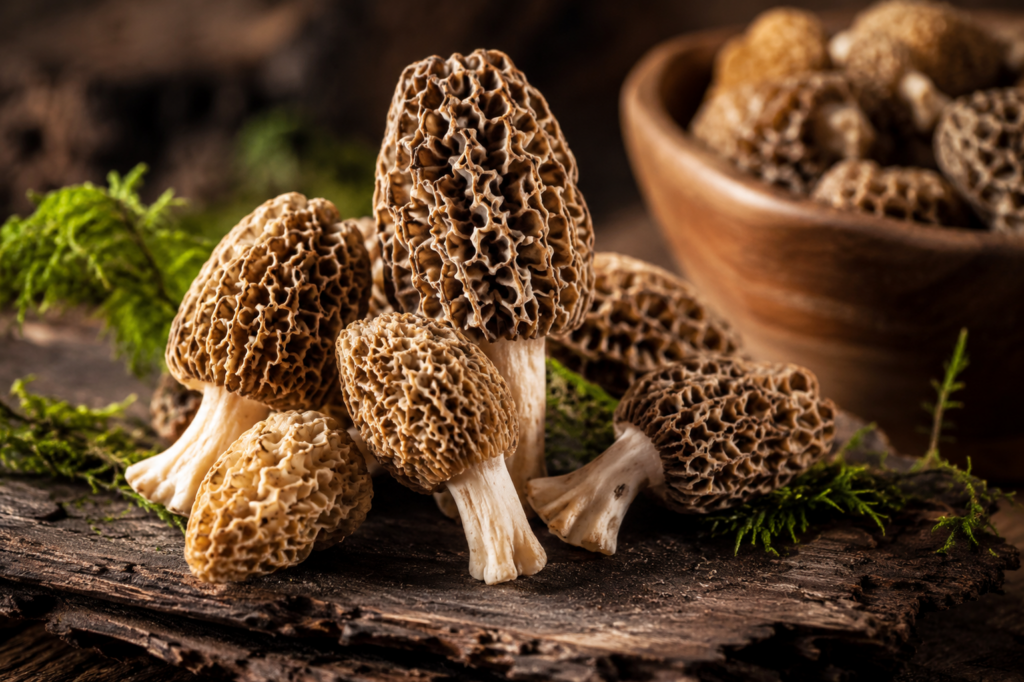
The Morchella esculenta mushroom has a very distinctive appearance that nothing else mimics:
- The cap has a characteristic honeycomb or pitted appearance, irregular ridges and depressions that look like an uneven waffle pattern.
- The cap and stem are hollow when you cut or break them open.
- The stem is usually lighter in colour than the cap.
- The aroma of dried Guchchi is earthy, slightly nutty, deeply mushroomy , distinct from any other dried mushroom.
If what you receive doesn’t have the honeycomb cap structure, contact the seller immediately. No other mushroom species legally or culinarily substitutes for Guchchi.
Buy Wild Guchchi from Kinnaur -Genuine, Tribal-Collected
Morchella esculenta. Wild-collected from Kinnaur’s forests each spring. FSSAI certified. Cannot be cultivated. Limited stock. Pan-India delivery.
Buy Guchchi → Limited Availability /product/guchhi-morel-mushrooms/
Frequently asked questions
Can I freeze rehydrated Guchchi?
Yes , once rehydrated, Guchchi can be frozen for up to 3 months. Freeze in portions with some of the soaking liquid for best results. Thaw in the refrigerator overnight before use.
Is there a vegetarian replacement for Guchchi in recipes?
Nothing replicates Guchchi’s specific earthy umami. Dried porcini mushrooms (bolete family) are the closest analogue in flavour profile ,both have a deep, meaty earthiness. The texture and appearance are completely different, but as a flavour substitution in a pulao or risotto-style dish, dried porcini is the best option.
How do I know if my dried Guchchi has gone bad?
Musty or off smell (as opposed to the characteristic earthy mushroom smell), visible mould, or soft/moist texture (dried mushrooms should be firm and very dry) are signs to discard. Properly stored dried Guchchi lasts 12–18 months in a sealed container away from moisture.