
White Honey vs Multiflora Honey: Which Chamba Himalayan Honey Should You Buy?
Most people who buy honey don’t think about what type they’re buying. Honey is honey -amber, sweet, from a hive. Until you taste the difference between a raw white honey from a specific alpine flower mix and a generic processed supermarket honey, the distinction seems academic. It isn’t.
Raw honey from Chamba’s Himalayan forests — whether white or multiflora -is a fundamentally different product from commercial processed honey. But white and multiflora are also different from each other, and understanding which suits you determines which you should buy.
This guide is written by the people who source directly from Chamba’s beekeepers. We sell both varieties. We have a financial incentive to recommend both. We’d rather give you an honest comparison and let you decide which fits your needs — because you’ll keep ordering the right one much longer than if we just told you to buy whichever is more expensive.
The Underlying Difference: Flower Sources
Both our White Honey and Multiflora Honey come from the same geographic source -the forests of Chamba district, Himachal Pradesh. The difference is which flowers the bees primarily visited when making each batch.
| White Honey | Multiflora Honey |
|---|---|
| Primary flower sources Sage, alfalfa, fireweed, white clover -specific altitude flowers with narrow bloom windows |
Primary flower sources Dozens of alpine wildflowers, meadow blossoms, shrubs — whatever is in season across the landscape |
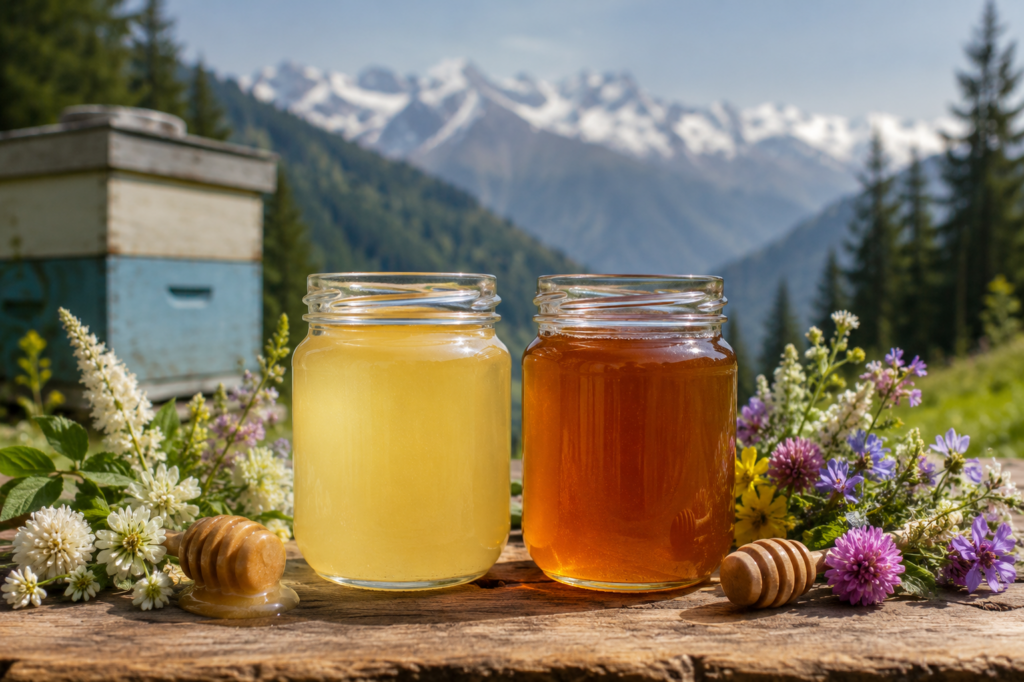
| Colour Very light amber, nearly translucent |
Colour Medium to dark amber -varies by batch and season |
| Flavour Mild, delicate, subtly sweet -the lightest honey character |
Flavour Richer, more complex, fuller honey character -the more “honey-forward” of the two |
| Texture Often slightly thicker -certain flower nectars produce slower-crystallising honey |
Texture Variable -more diverse flower sources means more variable crystallisation rate |
| Phytonutrient profile Concentrated from specific flowers -highly specific flavonoid types |
Phytonutrient profile Broader diversity -more types of phytonutrients in lower individual concentrations |
| Price Higher -specific flower sources are less abundant, shorter bloom window |
Price More accessible -more consistent and abundant supply |
| Best for Gifting, teas, direct eating, those new to raw honey who want the mildest entry |
Best for Daily cooking use, baking, chai, those who prefer fuller honey flavour |
The Raw Honey Question -Why It Matters for Both
Before the White vs Multiflora comparison matters at all, the more important question is whether you’re buying raw honey at all. Both our honeys are raw — never heated above 40°C. Commercial processed honey is typically heated to 70°C+ during processing, which destroys:
- Enzymes (amylase, invertase, glucose oxidase) — natural compounds responsible for honey’s antibacterial properties.
- Phytonutrients — flavonoids, phenolic acids, propolis traces — the compounds with the most documented health associations.
- Pollen — which provides additional antioxidants and is responsible for some of honey’s flavour complexity.
Processed honey is essentially flavoured glucose-fructose syrup with some minerals. It tastes like honey because it started as honey. Raw honey is a living food with active compounds intact.
This distinction applies to both our White and Multiflora varieties -the raw/processed distinction is more important than the White vs Multiflora distinction.
White Honey -Who It’s For, When to Buy It
White honey is the right choice when:
- You want the mildest possible flavour. White honey’s delicate character means it complements without dominating. It’s the best honey for use in teas where you don’t want honey flavour to overpower the tea itself.
- You’re gifting. The light colour and elegant flavour make white honey the more prestigious of the two for gifting contexts. It photographs beautifully and the name has clarity.
- You’re new to raw honey. If someone has been eating processed supermarket honey, the jump to raw honey is easier through white honey -the flavour is familiar and non-challenging.
- You want it for direct eating or simple applications. A teaspoon of white honey directly, on bread, in warm lemon water -where the honey itself is the feature, not a cooking ingredient.
Multiflora Honey -Who It’s For, When to Buy It
Multiflora is the right choice when:
- You want a proper honey flavour in cooking. Marinades, dressings, baked goods, chutneys — anywhere honey needs to come through clearly, multiflora’s fuller character holds up.
- You’re making chai. The richer character of multiflora works better with strongly flavoured masala chai than the delicate white honey.
- You want the most polyphenol diversity. Multiflora honey draws from dozens of flower species — a broader spectrum of phytonutrients from different plant sources. The diversity is genuinely wider, even if no single compound reaches the concentration of a monofloral honey.
- You’re buying as a daily-use household honey. At ₹250 for 250g — the most accessible entry price — it’s the practical everyday choice for households going through significant quantities.
Practical Guide: How to Use Each
| Use | Best Honey | Why |
|---|---|---|
| Drinking warm tea (delicate flavours) | White | Mild character doesn’t overpower the tea |
| Masala chai and spiced drinks | Multiflora | Fuller character holds its own against spices |
| Gifting | White | More premium positioning, elegant colour |
| Cooking marinades and glazes | Multiflora | Stronger flavour survives heat and reduces well |
| Baking | Multiflora | Fuller honey character contributes to baked flavour profile |
| On bread or direct eating | Either – preference | White is milder; Multiflora more assertive |
| Face mask or skincare | Either | Raw honey properties are comparable in both |
| Daily morning wellness tonic | Either | Both raw; either works for warm water with lemon |
Common Questions About Honey from Chamba
Why does raw honey crystallise?
Crystallisation is normal and natural -it is not spoilage. Raw honey crystallises because of its natural glucose content, and the rate depends on the flower sources and glucose-to-fructose ratio. White honey, with its specific flower profile, may crystallise faster or slower than Multiflora depending on the batch.
To re-liquefy: place the sealed jar in warm water (below 40°C, never boiling or microwave) and stir gently.
Is honey safe for infants?
No, honey of any type should not be given to children under 12 months. Raw honey can contain Clostridium botulinum spores. This is a hard food safety rule with no exceptions for honey type or quality.
How do I know if my honey has been adulterated?
Signs of adulteration:
- Immediate dissolution in cold water
- Very uniform golden colour with no natural variation
- Very low viscosity (watery consistency)
- Little or no natural fragrance
Our honey from Chamba beekeepers is fully traceable, if you ever have any concern about a batch, contact us.
Shop Raw Himalayan Honey -Direct from Chamba Beekeepers
White Honey (mild, delicate, premium) and Multiflora Honey (rich, affordable, everyday), both raw, both FSSAI certified, both from Chamba’s forests.