
The bag of mixed nuts in your kitchen pantry almost certainly has no origin story. No district, no farmer, no harvest year. It was assembled somewhere from several sources, treated with oil or preservatives for shelf stability, and sold on the basis of its category name rather than its provenance. This is the default state of nuts in India, and it’s completely unnecessary, because some of the most nutritionally exceptional nuts in the world grow right here, in the Himalayan valleys of Himachal Pradesh.
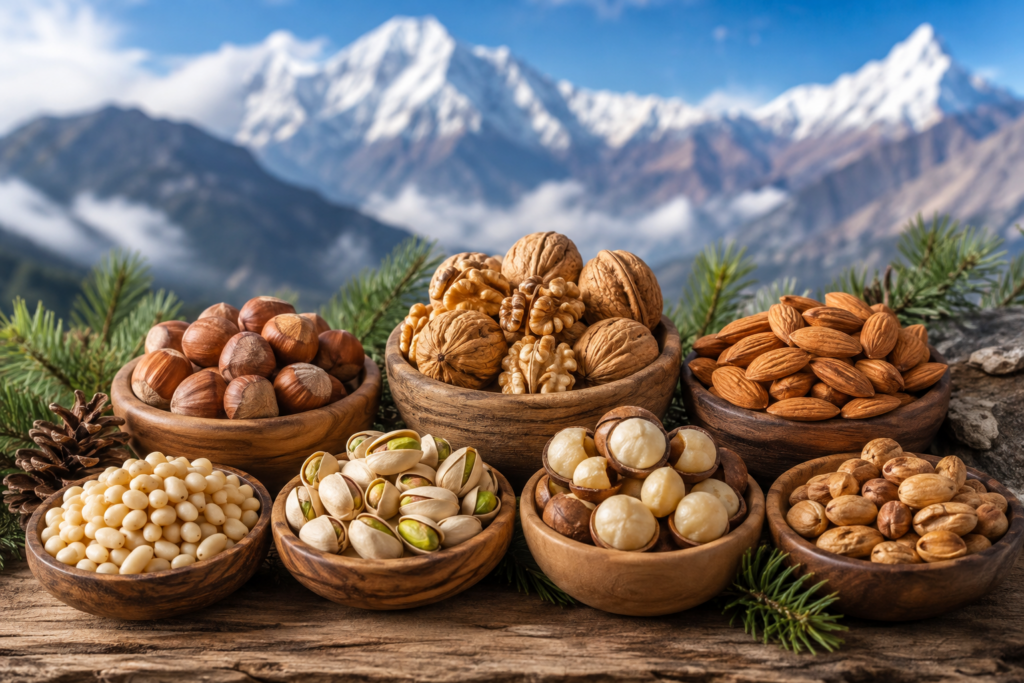
This guide covers the seven nuts we source from Kinnaur and surrounding regions, what they are, what the nutritional research says about each, and how to use them. No filler, no generic health claims, and no pretence that buying Himalayan nuts will transform your health overnight. What they will do is give you a genuinely better nut, more flavour, more nutrition, and a story worth knowing.
Why Kinnaur is India’s best nut-growing region
Kinnaur district in Himachal Pradesh sits between 1,400 and 2,500 metres above sea level. The growing conditions are demanding: thin soils, extreme temperature variation, limited water, and an altitude where synthetic agricultural chemistry is both expensive to transport and culturally uncommon among the tribal farming communities who work the land. The result is slow growth, high nutrient density, and chemical-free produce, not because of a certification programme, but because of geography.
Direct sourcing from these communities, which is what we do at Kinnaur Organic, means you get the produce at its best, without the quality degradation that comes from multiple commercial handling stages.
Nut 1: Kinnaur Walnuts (Akhrot)
Walnuts are among the most researched nuts in nutritional science. The Omega-3 (ALA) content of walnuts, approximately 2.5g per 28g serving, is among the highest of any nut, and consistent research links walnut consumption with cardiovascular health markers, cognitive function support, and anti-inflammatory effects.
Kinnaur walnuts have a slightly sweeter, richer flavour profile than Kashmiri varieties, a product of the specific microclimate and soil composition of Kinnaur’s orchard valleys. They are available shelled (ready to eat) or unshelled (in-shell, for maximum freshness).
- Best for: Daily snacking, akhrot chutney, halwa garnish, baking, soaking overnight for Ayurvedic morning practice.
- Also available: Kinnaur Walnut Oil, cold-pressed from the same orchards, rich in Omega-3, excellent as a finishing oil.
→ Shop Kinnaur Walnuts (Shelled) | Kinnaur Walnuts (Unshelled) | Walnut Oil
Nut 2: Chestnuts
Chestnuts are unique in the nut world: they are the only tree nut that is high in complex carbohydrates and low in fat. This makes them nutritionally more like a grain than a nut, low in calories (approximately 245 per 100g compared to 600+ for most nuts), high in Vitamin C (unusual for a nut, approximately 40mg per 100g), and rich in copper and manganese.
Kinnaur chestnuts are seasonal, available from October to December only, harvested from the trees that grow across the valley. They are genuinely fresh produce, not stored commodity.
- Best for: Roasting (15–20 min with scored shells), boiling, singhare ki sabzi (Himachali chestnut curry), kheer, stuffing.
- Important: Seasonal only. Use the “Notify Me” feature on the product page to be first when the October harvest comes in.
Nut 3: Hazelnuts
Hazelnuts have one of the highest Vitamin E contents of any nut, approximately 15mg per 100g, combined with very high oleic acid (Omega-9) and a rich diversity of antioxidants. Research has linked regular hazelnut consumption with improved LDL cholesterol profiles and cardiovascular health markers.
India grows limited quantities of hazelnuts domestically, concentrated in specific Himalayan valleys including Kinnaur. This makes Indian-grown hazelnuts significantly less available than imported Turkish or Italian varieties, but also free of import transit quality degradation.
- Best for: Snacking (toasted for best flavour), baking, hazelnut chutney, granola, homemade hazelnut butter, chocolate combinations.
Nut 4: Pine Nuts (Chilgoza)
Chilgoza, the local name for the pine nuts of the Pinus gerardiana tree in Kinnaur, are botanically and culinarily the same as the “pine nuts” used in global cooking. They are wild-harvested from forest trees rather than cultivated, which is why they are inherently limited in supply. Chilgoza contains pinolenic acid, a fatty acid found almost exclusively in pine nuts, studied for its potential role in triggering satiety hormones.
High in Vitamin B1, B2, iron, and magnesium, with a buttery, mildly resinous flavour, Chilgoza is a genuine Himalayan superfood that most Indians know by local name rather than its global counterpart.
- Best for: Dry fruit snacking, biryani garnish, mithai mixes, pesto, salad topping, sweet dishes.
→ Shop Kinnaur Chilgoza (Pine Nuts)
Nut 5: Kinnaur Almonds (Kinnauri Badam)
The Kinnauri Badam is distinguished from all other Indian almond varieties by one characteristic: its paper-thin shell. Where Kashmiri almonds require a nut cracker, many Kinnauri almonds can be cracked between two fingers. The thin shell reflects the specific growing conditions of Kinnaur’s microclimate, and may indicate a denser, more flavourful kernel.
Nutritionally, Kinnauri almonds are exceptional for Vitamin E (approximately 25mg per 100g), magnesium, protein (21g per 100g), and monounsaturated fats. Sold unshelled for maximum freshness.
- Best for: Daily snacking (cracked fresh), Ayurvedic soaking practice, almond milk, laddoos, garnishing sweets and biryanis.
→ Shop Kinnaur Almonds (Unshelled)
Nut 6: Pecan Nuts (Pangi Valley, Chamba)
Almost no Indian buyer knows that India grows its own pecan nuts. In the Pangi Valley of Chamba district, Himachal Pradesh, pecan trees planted decades ago have adapted to the extreme mountain climate and now produce nuts that compare favourably to US commercial pecans, without the import premium, the air freight carbon footprint, or the chemical inputs typical of large commercial US pecan orchards.
Pecans have one of the highest antioxidant ratings (ORAC) of any nut, are rich in gamma-tocopherol (a specific Vitamin E form with strong antioxidant research), and have high monounsaturated fat content for cardiovascular health.
- Best for: Snacking (toasted), pecan barfi and laddoos, banana bread, candied pecans, salad toppings.
→ Shop Pangi Valley Pecan Nuts
Nut 7: Walnut Oil
Technically an oil rather than a nut, walnut oil from Kinnaur deserves a place in this guide because it’s the easiest way to incorporate Himalayan walnut nutrition into your daily routine without cracking and eating a handful of walnuts. Cold-pressed from the same Kinnaur orchards at ₹650, it is rich in Omega-3 and Vitamin E and functions best as a finishing oil or dressing base, not for high-heat cooking.
- Best for: Salad dressings, drizzled over dals and vegetables after cooking, hair oil treatment, daily Omega-3 supplement (1 tbsp).
How to store Himalayan nuts
| Nut | Room temperature | Refrigerated | Frozen |
|---|---|---|---|
| Walnuts (shelled) | 2–3 months in airtight container | 4–6 months | Up to 12 months |
| Walnuts (unshelled) | 6–8 months cool and dry | Not needed | Up to 24 months |
| Chestnuts (fresh) | 2–3 days only | 2–3 weeks in paper bag | 3 months (roasted and peeled) |
| Hazelnuts | 1–2 months | 3–4 months | Up to 12 months |
| Chilgoza (Pine Nuts) | 1–2 months | 3–4 months | Up to 9 months |
| Kinnaur Almonds (unshelled) | 6–8 months cool and dry | Not needed | Up to 24 months |
| Pecan Nuts | 4–6 weeks | Up to 6 months | Up to 24 months |
Shop All Kinnaur Himalayan Nuts
Chemical-free. Direct from Kinnaur orchards and forests. FSSAI certified. Seven varieties available online with pan-India delivery.
, Kinnaur Organic Drinks & Foods sources all its nuts directly from tribal farming families and forest communities in Kinnaur district, Himachal Pradesh. FSSAI.
About the author
Kinnaur Organic Team, Direct-sourcing specialists for organic Himalayan produce. Available at Himachal Emporium, New Delhi.